| Up
to the early 20th century in this Land, it was the tradition to
pass verbally, from one generation to the next, any information
about the ages of trees. Old estate papers might have recorded what
plants were planted and when, at their new Pleasure Garden in the
18th century, and early papers reveal what was bought and planted,
as new valuable species arrived in the country, in the Age of Exploration
and Discovery. Alas, there was little about fruit trees and the
number of such documents are too few to help. Besides which, the
grand garden was subject to such whim, change and a preference for
ornamentals, with fruit relegated to the kitchen garden, that notes
on early buyings and plantings of fruit trees were 1) very rare
2) were unlikely to survive. Tantalizingly, the most interesting
trees turn up in strange peripheral places on such estates, outside
any known phase of a garden design. They appear to have existed
from a time before land enclosures, re-building and re-landscaping
became the craze in the 17th and 18th centuries. Meanwhile, for
lack of literacy and through no desire to retain old domestic writings,
the plantings in more parochial settings have not survived, passing
only by word of mouth and lasting only in memory. In fruit growing
counties there are second hand accounts in old literature of how
aged locals would assert the age of individual perry pear trees
to be over 300 years, but we have found nothing of significance
for other fruits.
Enquiry
into the possible age of fruit trees might reasonably be supposed
to have occupied the minds of the great thinkers of the past, but
it was not recorded. The ancient Greek, Theophrastus, around 300BC,
was really the first to make any enquiry into the nature and habits
of plants, following on from his master, Aristotle, the latter restricting
his philosphies more to the nature of matter and Man. Theophrastus
did not speculate on the age of fruit trees, though he was fully
acquainted with them and with grafting techniques and such like.
From 50-100AD Pliny the Elder and Pliny the Younger had a few things
to say about the world around them, including fruit trees, but they
made no estimates or observations on age. Through the Roman occupation,
the Dark Ages and beyond the Norman Conquest, the subject did not
crop up in the limited available literature. No-one really cared
- until nearly 400 years ago, when the age of natural philosophy
and considered writings began to start up again. Enter, William
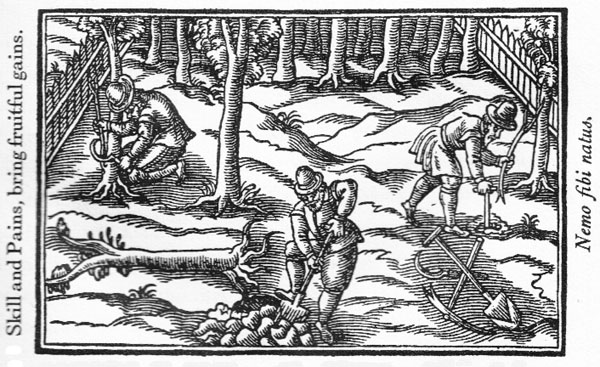
Lawson- writer of the A New Orchard and Garden, Published With The
Country Housewife’s Garden in 1618. This was effectively the
first real gardening book. He seems to have been the first person
in history to ask the question ‘how long can a fruit tree
live’? He said-
“Of good things the greatest, and most durable is alwaies
the best. If therefore out of reason grounded upon experience, it
be made (I thinke) manifest, but I am sure probable, that a fruit
tree in such a soile and site, as is described so planted and trimmed
and kept, as is afore appointed and duely foiled, shall dure 1000
yeeres, why should we not take paines, and be at two or three yeeres
charges (for vnder seuen yeeres will an orchard be perfected for
the first planting, and in that time be brought to fruit) to reape
such a commodity and so long lasting.”.......
He
goes on to speak of trees in his possession for 40 years but perhaps
100 years old according to the testimony of 80 year old acquaintances.
“that
I assure my selfe they are not come to their growth by more than
2. parts of 3. which I discerne not onely by their owne growth ,
but also by comparing them with the bulke of other trees. And I
find them short (at least) by so many parts in bignesse, although
I know those other fruit-trees to haue beene much hindred in their
stature by euill guiding. Herehence I gather thus".
“If
my trees be a hundred yeeres old, and yet want two hundred of their
growth before they leaue encreasing, which make three hundred, then
we must needs resolue, that this three hundred yeere are but the
third part of a Trees life, because (as all things liuing besides)
so trees must have allowed them for their increase one third, another
third for their stand, and a third part of time also for their decay.
All which time of a Tree amounts to nine hundred yeeres, three hundred
for increase, three hundred for his stand, whereof we haue the terme
stature, and three hundred for his decay, and yet I thinke (for
we must coniecture by comparing, because no one man liueth to see
the full age of trees) I am within the compasse of his age, supposing
alwaies the foresaid meanes of persuing his life.”
He
goes on to consider the life-spans of other living things arguing
that an un-laboured, healthy and replete life increases life-span.
“Euery
liuing thing bestowes the least part of his age in his growth, and
so must it needs be with trees. A man comes not to his full growth
and strength (by common estimation) before thirty yeeres, and some
slender and cleane bodies, not till forty, so long also stands his
strength, & so long also must he haue allowed by course of nature
to decay. Euer supposing that he be well kept with necessaries,
and from and without straines, bruises, and all other dominyring
diseases. I will not say vpon true report, that Physicke holds it
possible, that a cleane body kept by these 3. Doctors, Doctor Dyet,
Doctor Quiet, and Doctor Merriman, may liue neere a hundred yeeres.
Neither will I here vrge the long yeeres of Methushalah, and those
men of that time, because you will say, Mans dayes are shortened
since the floud. But what hath shortned them? God for mans sinnes:
but by meanes, as want of knowledge, euill government, ryot, gluttony,
drunkenesse, and (to be short) the encrease of the curse, our sinnes
increasing in an iron and wicked age.”
After
an enquiry into the many ways that man shortens his life, and arguing
that a good life could double man’s years compared to the
life of the dissolute human, and a few other interesting observations
he resumes –
“So
I resolve vpon good reason, that fruit-trees well ordered, may liue
and like a thousand yeeres, and beare fruit, and the longer, the
more, the greater, and the better, because his vigour is proud and
stronger, when his yeeres are many. .......”
His
was a bold and brave attempt, and recorded here mainly for the beauty
of the prose.
One
would have thought that John Parkinson would have taken up the subject
in his Paradisus in Sole of 1629, but he did not. (Neither had Gerard
in his Herbal of 1597)
John
Evelyn in his Sylva of 1664 had much to observe and recommend about
the planting of trees, including fruit trees but had nothing to
say on their potential ages.
The
response to Lawson was 68 years in coming, when John Ray published
his Historia Plantarum in 1686. He said -
“Lawson,
a writer on horticulture not uncelebrated, strives to prove with
reasons not to be despised that our fruit trees too, Malus and Pyrus,
prolong their lives for as much as 900 years”
Ray
then repeats Lawson’s reasons. Ray continues-
“But
let us have done with these reasons however plausible; we want proofs
not arguments. What is said about the longevity of trees does not
easily find faith with me. For since there are not any, or only
very rare, pieces of evidence recorded in literature worthy of belief
about the times at which trees were first planted, what is passed
down concerning their age consists of uncertain and ill-founded
rumours and opinions, and so either seems entirely false and fabulous
to me, or uncertain and full of conjecture.”
Ray
was right! We want proofs, not arguments. But there is something
compelling about Lawson, however unproven his argument. Alas, no-one
recorded their tree plantings in the early years, which would allow
the limits to be known. We can keep our current records safe and
wait a few hundred years – to prove the matter beyond doubt,
to the sceptics – or we can be impatient and fall back on
faith, bolstered by the evidence that we do have.
That
is the end of the trail for early writings on the age of fruit trees.
Nothing more is to be found there. It was not until the end of the
18th century that the matter was re-ignited. As far as the potential
age of trees was concerned, while tinder and flame were added, the
re-ignition barely reached combustion, though much heat was generated
when it came to the preservation of old trees. It is worth taking
a side road to cover it.
|